|
|
|
 |  | |  | |  | |  | |  | |  | |

|
||||||||||||||||||||||||||||||||||||||||||
|
|
|
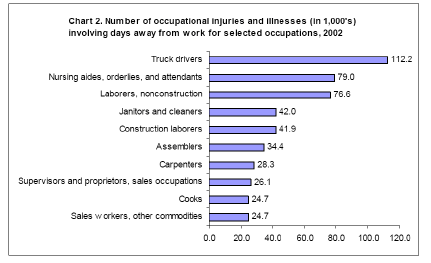
Lost-worktime injuries and illnesses of Nursing Aides, Orderlies, and AttendantsTeresa Scherzer, Susan Chapman, and Robert NewcomerThe latest data released by the U.S. Department of Labor reveals that in 2002, the occupational group "Nursing Aides, Orderlies, and Attendants" had the second-highest number of occupational injuries and illnesses that resulted in missed workdays, compared to all other occupational groups. The data indicate that most (91%) of the 79,000 injured Nursing Aides, Orderlies, and Attendants were women who suffered back injuries related to lifting or moving patients. Excerpts from the Dept. of Labor report follow below. Chart 2 (below) indicates the number of occupational injuries and illnesses involving days away from work, for the ten occupations that account for one-third of the cases requiring recuperation away from work in 2002. The occupation "Nursing Aides, Orderlies, and Attendants" is ranked second.
Table B (below) indicates the number of work-related musculoskeletal disorders (primarily back injuries) involving missed workdays, for the ten occupations with the most musculoskeletal disorders in 2002. Nursing Aides, Orderlies, and Attendants had the greatest number of musculoskeletal disorders (44,400) compared to all other occupations, with a median of six missed workdays because of the injury.
Source:"Lost Worktime Injuries and Illnesses: Characteristics and Resulting Days Away From Work, 2002." March 25, 2004. Bureau of Labor Statistics, United States Department of Labor. Internet address: http://www.bls.gov/iif/home.htm. Technical notes:The Bureau of Labor Statistics (BLS) job classification "Nursing Aides,
Orderlies, and Attendants" includes workers in both home-based and institutional
settings. BLS survey estimates of the characteristics of cases with days away from work are based on a scientifically selected probability sample, using two levels of sampling. Establishments were selected, and then those sampled establishments projected to have a large number of days away from work cases were instructed before the survey began on how to sample those cases to minimize the burden of their response. Data are subject to sampling error, however standard errors and 95% confidence intervals were calculated for each estimate, in order to generalize to the entire population. Nonsampling error (e.g., mistakes in recording the data) may also influence results, but BLS has implemented quality assurance procedures to reduce this.
|
||||||||||||||||||||||||||||||||||||||||